Quick answer
Every MOE primary school has at least 2 SEN Officers. The school picks children for the Learning Support Programme (English) and LSM (Mathematics) at the start of P1. Dyslexia support runs in P3 and P4. For the PSLE, the school applies to SEAB for access arrangements by mid-February of the exam year.
The useful number: At least 2 SEN Officers in every MOE primary school: ask the school who they are.
Questions to ask the school, dated
Choose your child’s level this year. Each question gets the school year it belongs to; tick it once asked.
Loading the official figures…
Who is this for?
Parents of a P1 to P6 child in a MOE primary school who finds reading, spelling, maths, attention or behaviour hard. It also helps if your child already has a diagnosis.
MOE says mainstream schools can support children with ADHD, dyslexia, hearing loss, mild autism spectrum disorder, physical impairment and visual impairment. This guide never decides whether your child has a learning need. The school and the professionals who assess your child do that.
Who helps in school?
- SEN Officers. They provide in-class support and individual or small group intervention and skills training. All primary schools have at least two SEN Officers, and secondary schools have at least one SEN Officer.
- The older name. MOE's 2020 reply calls the same staff Allied Educators (Learning and Behavioural Support), or AEDs(LBS). It says each school has one to two. Some school websites still use it.
- Teachers. Teacher Leaders for Learning Needs (Special Educational Needs) mentor teachers and share strategies for diverse learners. Teachers Trained in Special Needs share strategies with their colleagues.
- MOE Educational Psychologists. They regularly visit schools to provide consultation regarding support for students with SEN.
Start with your child’s form teacher. For more information, contact your child's school or SEN Officer.
Which programmes are there, and when?
MOE’s programmes, in school order. The school decides who joins.
| Programme | Levels | Who joins | What it looks like |
|---|---|---|---|
| Learning Support Programme (LSP)English | P1 and P2 | At the start of P1 | Half an hour a day, in small groups of 8 to 10 students, by trained teachers |
| Learning Support for Mathematics (LSM)Mathematics | P1 to P4 | At the start of P1; more children may join in P2, P3 or P4 if needed | P1 and P2: 4 to 8 periods a week, groups of up to 8. P3 and P4: 11 periods a week, groups of up to 15 |
| TRANsition Support for InTegration (TRANSIT)Social and behavioural skills | P1 | From what parents and teachers say, and trained school staff's observations | Self-management, work habits, social and communication skills, and managing emotions. In all primary schools by 2026 |
| Mother Tongue Support Programme (MTSP)Mother Tongue | P3 and P4 | In P2, to join in P3 | Small groups of 8 to 12 students, by trained teachers |
| School-based Dyslexia Remediation programmeReading and spelling | P3 and P4 | Children with continued literacy difficulties in P3 and P4 who are diagnosed with dyslexia | Teachers trained in the programme teach phonics, sight words and reading comprehension strategies |
| Main Literacy Programme (Dyslexia Association of Singapore)Literacy, outside school | Primary school | Children with dyslexia who meet the subsidy rules | MOE-subsidised. MOE's page gives no fee; ask the school or the Dyslexia Association of Singapore |
MOE’s pages give no fee for the school programmes.
How is a child picked for support?
- Start of P1: the school picks children for LSP and LSM. For LSM, more children may join in P2, P3 or P4 if needed.
- P1: for TRANSIT, the school uses what parents and teachers say and what trained staff observe. Tell the form teacher what you see at home.
- P2: children are picked for the Mother Tongue Support Programme, which runs in P3 and P4.
- P3 and P4: the dyslexia programme is for children with continued literacy difficulties in P3 and P4 who are diagnosed with dyslexia.
- Any time you are worried: write down what you see at home, then ask the form teacher for a meeting with the SEN Officer.
Want a professional assessment? For children below 7, MOE lists KKH’s Department of Child Development and NUH’s Child Development Unit. A referral from a polyclinic or CHAS clinic makes you eligible for a subsidy.
MOE also lists registered Educational or Clinical Psychologists on the Singapore Register of Psychologists. Bring your child’s medical records and school reports. MOE’s page gives no fees. Ask your doctor where to start.
How do PSLE access arrangements work?
Access arrangements let a child with special educational needs sit the PSLE in a way that fits those needs. SEAB decides.
- Who applies: the school applies for your child, through its SEN Officers, access arrangements coordinator or form teacher.
- When: up to one year before the national examination. The PSLE deadline is mid-February of the PSLE year. Late applications are not accepted.
- Too late: For learning disabilities, applications sent less than two months before the examination are not accepted.
- What the school needs:
- A report that states the diagnosis, from a registered professional (for example on the Singapore Register of Psychologists).
- For some arrangements, such as a reader or a scribe: a current profile of needs. It must be dated within three years of the exam year.
- A School Observation Report from the school.
- The outcome: usually by April of the examination year, through the school.
- Examples:
- Extra time, about 25% of the paper's time in most cases
- Enlarged print papers
- A reader, scribe or prompter
- A separate room
- Aids such as a magnifier, reader pen or word processor
- On the result slip: SEAB says a result slip and certificate may show a symbol next to a subject. This happens when arrangements greatly change the usual conditions. The condition itself is not shown.
- Changing your mind: To withdraw, ask the school at least five working days before the papers start. Once withdrawn, the arrangements cannot be put back.
What happens at the end of P4?
- P4: School exams. At the end of the year the school recommends a subject combination from the results. You fill in an option form with your preferred combination.
- P5: Your child takes the preferred combination. At the end of P5 the school checks how your child is coping, and subject levels are adjusted if needed.
- P6: Your child takes the combination the school recommends and sits the PSLE.
A child who passes 3 or more subjects is offered 4 Standard subjects. A child who passes 2 or fewer can choose from 4 Standard to 4 Foundation subjects. MOE says: “Taking subjects at the foundation level is not a disadvantage for your child.”
See what each mix changes for the PSLE Score, Posting Groups and S1 subject levels with Subject levels at P4.
How do we get ready for a teacher meeting?
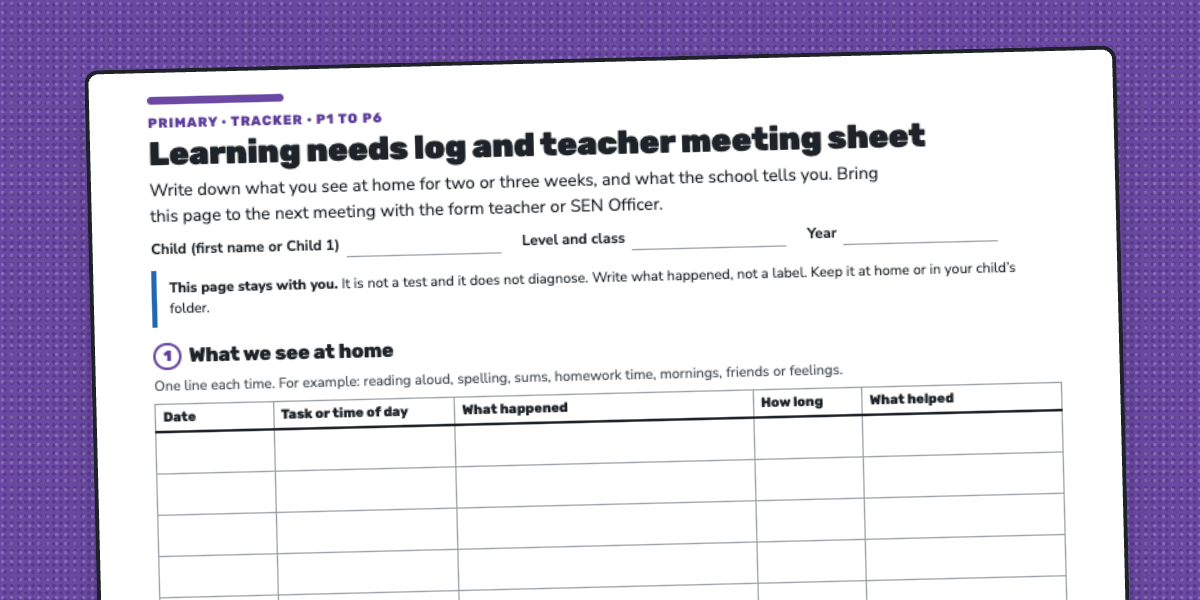
Print the learning needs log and teacher meeting sheet. Fill in what you see at home for two or three weeks before you meet. Write down what the school tells you, and the questions above for your child’s level.
Keep your child’s reports and any assessment in one folder. SEAB asks for a recent profile of needs for some access arrangements.
Is there help outside school?
MOE lists one: the Main Literacy Programme run by the Dyslexia Association of Singapore. It is MOE-subsidised for children with dyslexia who meet the subsidy rules. MOE's page gives no fee; ask the school or the Dyslexia Association of Singapore.
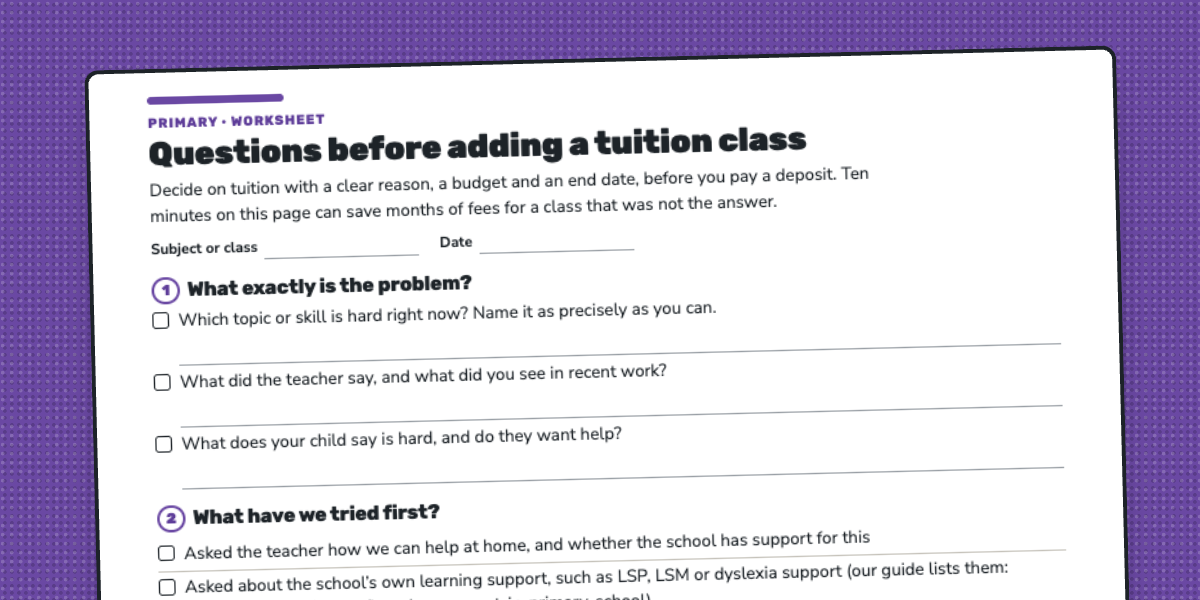
Thinking about tuition? Read Questions before adding a tuition class first, and ask the school what support your child already gets. If money is tight, see Help if money is tight.
What does this guide not tell you?
It is general information from MOE and SEAB. It does not diagnose or grade your child, and it cannot say which programme or subject level is right. The school and the professionals who know your child decide. Ask your doctor about any health or development worry.
Printables for this guide
Learning needs log and teacher meeting sheet
Log what you see at home and what the school reports, then take questions to the teacher or SEN Officer and note what you agreed. Never a diagnosis.
Questions before adding a tuition class
Set a reason, a budget and an end date before paying a tuition deposit. Name the problem, try free options, check the week and cost, and set a review date.
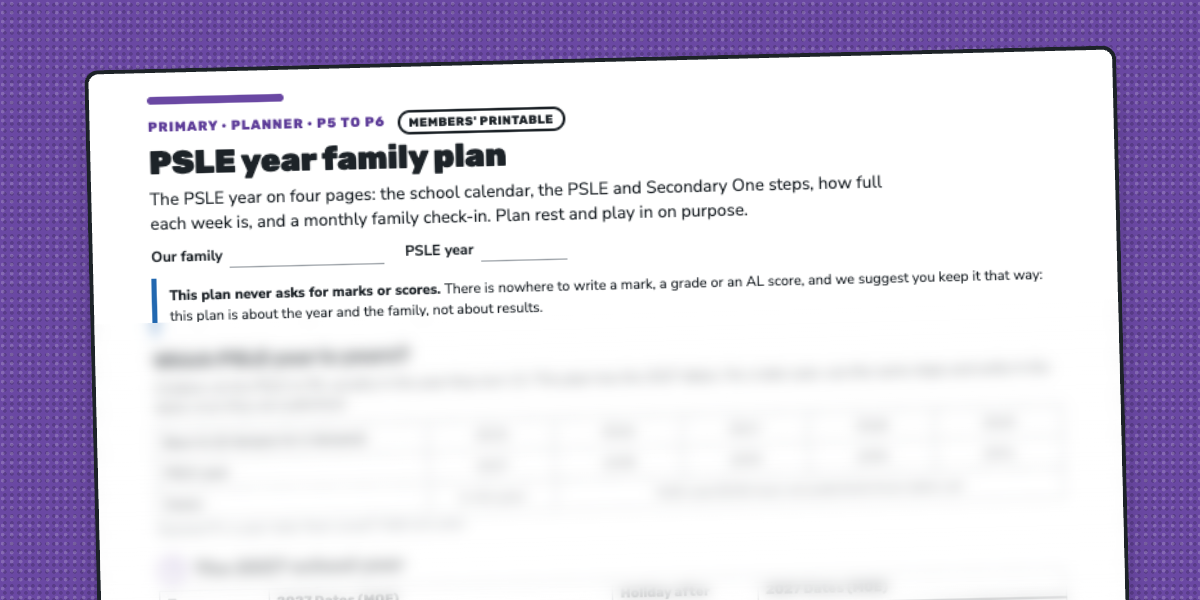
PSLE year family plan
The 2027 school calendar and SEAB and MOE's PSLE, DSA-Sec and S1 steps. A year planner, a rest, play and tuition tracker and a monthly check-in. No marks.
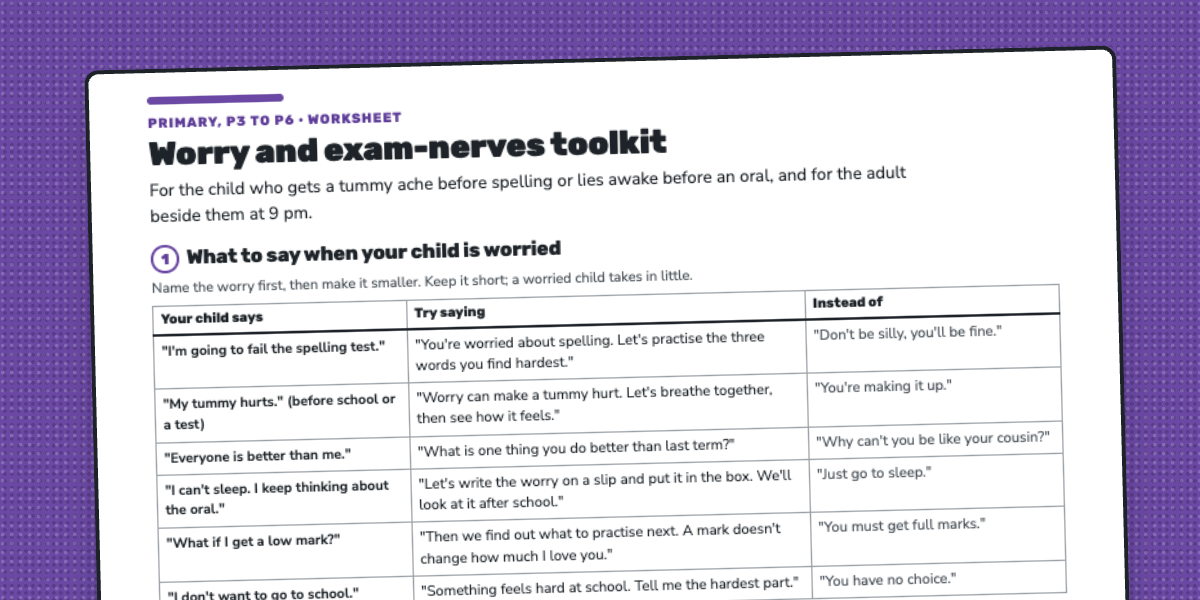
Worry and exam-nerves toolkit
For P3 to P6: what to say when your child is worried, breathing cards and worry slips. Plus an exam-week routine and where to get help.
Facing the P4 subject choice?
Pick Standard or Foundation for each subject to see the PSLE Score range, Posting Groups and S1 subject levels.
See what Foundation subjects change → Learning needs log and teacher meeting sheet → PSLE Score calculator →Frequently asked questions
Does my child need a diagnosis to get help in school?
Not for every programme. The school picks children for LSP and LSM at the start of P1. MOE says the dyslexia programme is for children diagnosed with dyslexia, and SEAB asks for a diagnosis report for access arrangements.
Who applies for PSLE access arrangements?
The school applies to SEAB for your child, through its SEN Officers, access arrangements coordinator or form teacher. Talk to the school early.
When is the deadline for PSLE access arrangements?
SEAB’s deadline is mid-February of the PSLE year, and late applications are not accepted. The school can apply up to one year before the exam.
Will access arrangements show on the PSLE certificate?
SEAB says a symbol may appear next to a subject when the arrangements greatly change the usual conditions. Your child’s condition is not shown.
Is taking Foundation subjects a disadvantage?
Ask the school how it would work for your child. MOE says: “Taking subjects at the foundation level is not a disadvantage for your child.”
Keep this guide for the next big decision.
Build your own reading list and pick up where you left off with a free RaisingAngels account.
Free account · Tools stay free without an account.
Sources & assumptions
- MOE — Special educational needs support at mainstream primary schools ↗
- MOE — Learning support (primary school curriculum) ↗
- MOE EdTalks — How does MOE support students with special educational needs? ↗
- MOE parliamentary reply — Proportion of SEN students in mainstream schools and ensuring adequate training for teachers ↗
- MOE parliamentary reply — Allied Educators ↗
- MOE — Professional assessment for special educational needs ↗
- SEAB — Access arrangements ↗
- MOE — Subject-based banding (primary school) ↗
- MOE — Release of 2025 PSLE results ↗
The school, SEAB and the professionals who assess your child decide.