Quick answer
Start with a Social Service Office or the ComCare hotline, 1800 222 0000. ComCare’s guide is household income of S$800 a person a month or less, and an office can assess you even above it. For fees, ask your preschool or school about subsidies when you enrol.
See if ComCare can help ↗ (opens in new tab)
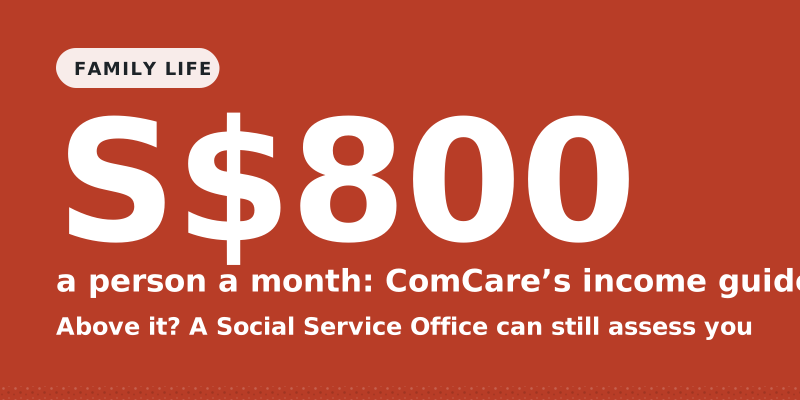
The useful number: ComCare’s guide is S$800 a person a month, but a Social Service Office can still assess a family above it.
Who is this for?
Parents in Singapore whose pay is low, has dropped or comes and goes: after a job loss, an illness, a new baby or a separation. Each scheme below says who it is for and how to ask. The agency decides; we never promise an amount.
Where do you start?
- Call the ComCare hotline, 1800 222 0000, or visit a Social Service Office. They look at work, family and money together, and can refer you to other help.
- Preschool or kindergarten: ask the centre about subsidies and fee help when you enrol. The centre sends the form.
- Primary or secondary school: ask the school office for the MOE Financial Assistance Scheme form.
- Student care: apply for SCFA on SupportGoWhere at least 6 months before your child starts.
- Every household: claim your CDC Vouchers.
- Keep recent payslips or CPF statements ready for everyone at home. Agencies look at the whole household’s income.
Can ComCare help with daily costs?
ComCare Short-to-Medium-Term Assistance, from MSF, can give:
- Monthly cash assistance for living expenses
- Help with household bills: rent, utilities, or service and conservancy charges
- Medical assistance at public healthcare institutions
- Help to find a job or training
- Referrals to other services
Who it is for: Singapore Citizen or PR, with at least one Singapore Citizen in the household. The guide is household income of S$800 a person a month or less, with little family support, savings or assets. It is for people looking for work, unable to work for a while, or on a low income.
Even if your income is above the guideline, you can still ask a Social Service Office (SSO) to assess you. The office assesses each household, so there is no fixed amount. Apply online on SupportGoWhere, or at your nearest Social Service Office.
What is KidSTART?
KidSTART supports families from pregnancy until the child turns 6:
- Home visits with one-to-one support
- Learning packs, fresh food packs and events
- Support from pregnancy until your child turns 6
Who it is for: A pregnant mother and/or a Singapore Citizen child aged 6 and below. Household income must be S$2,500 a month or less, or S$650 a person or less. Sign up on KidSTART’s site or call 6908 0155.
What help is there with infant care and childcare fees?
Every Singapore Citizen child at an ECDA-licensed centre gets the Basic Subsidy. The Additional Subsidy is for households earning S$12,000 a month or less, or S$3,000 a person in a household of 5 or more. From 1 January 2027, these rise to S$15,000 and S$3,400.
The main applicant (the mother or single father) usually needs to work at least 56 hours a month. Two exceptions:
- For childcare, a household earning S$6,000 a month or less (S$1,500 a person) gets full subsidies, working or not. From 1 January 2027 this is S$7,500 (S$1,700 a person).
- A mother who is not working can ask ECDA for Special Approval for a time. Reasons include: looking for a job; studying or training at least 56 hours a month; pregnant; medically unfit for work.
- Families in an HDB public rental flat, or on ComCare Short-to-Medium-Term or Long-Term Assistance, get the maximum subsidies until the next assessment.
Still finding the fees hard? Child Care Financial Assistance (CCFA) is for households earning S$3,500 a month or less (S$875 a person) in difficult family circumstances. A Start-Up Grant of up to S$1,000 helps with the deposit, registration and uniform. ECDA assesses each case. Apply with the subsidy form at enrolment.
Work out your Basic and Additional Subsidy with the Childcare subsidy calculator.
What about ECDA’s childminding pilot?
The pilot is for Singapore Citizen babies aged 2 to 18 months who are not in infant care. ECDA says its fees already include Government subsidies. You can also use your baby’s CDA money for the subsidised hours.
MSF says most families in the pilot use their baby’s CDA money this way. Neither ECDA nor MSF names any other fee help for the pilot. If the fees are still hard, ask a Social Service Office.
What help is there with kindergarten fees?
KiFAS helps with fees at Anchor Operator (AOP) or MOE kindergartens, for Singapore Citizen children. It is for households earning S$12,000 a month or less, or S$3,000 a person in a household of 5 or more. From 1 January 2027, SupportGoWhere says the limits rise to S$15,000 and S$3,400.
A KiFAS Start-Up Grant of up to S$240 a year covers the registration fee, deposit and uniform. It is for households earning S$1,900 a month or less (S$650 a person). Apply through the kindergarten. Compare MOE Kindergarten and childcare with the MOE Kindergarten or childcare tool.
What help is there with school costs?
The MOE Financial Assistance Scheme is for Singapore Citizen students in government and government-aided schools. It is for households earning S$4,000 a month or less, or S$1,000 a person.
- Primary school
- No miscellaneous fees
- Free textbooks and school attire
- Meal subsidies for 7 meals a school week
- Transport help: 70% of the monthly school bus fare, or S$21 a month for public transport
- Secondary school
- No school or miscellaneous fees
- Free textbooks and school attire
- Meal subsidies for 10 meals a school week
- Public transport help of S$21 a month
Families above the limit can ask the school, which looks at each request case by case. Apply online at go.gov.sg/moe-efasggas, or on the form from your child's school. One form covers brothers and sisters in other government schools.
What help is there with student care fees?
SCFA lowers student care fees for children aged 7 to 14 (Primary 1 to Secondary 2). It is for households of 4 or fewer earning S$4,500 a month or less, or S$1,125 a person in larger households. From 1 January 2027, the limits rise to S$6,500 and S$1,625.
The subsidy is up to S$290 a child a month, plus a one-time Start-Up Grant of up to S$400. For a single-parent household, MSF counts the applicant's income only. Online on SupportGoWhere, at least 6 months before the start date. See your fee after SCFA with Student care compare.
What does every family get?
Every Singaporean household can claim S$500 of CDC Vouchers 2026 (June): S$250 for hawkers and heartland shops, and S$250 for supermarkets. Use them by 31 December 2027. Claim at go.gov.sg/cdcv; no app needed.
Child Credits of S$2,000 a year go to each Singapore Citizen child turning 1 to 16 from 2026. The first payout is in April 2027, to your child’s PayNow-linked bank account: set it up before 1 April 2027. See what is still to come with the LifeSG credits tracker.
What is Grandparent Caregiver Relief, really?
It is an income tax relief of S$3,000 a year, not money for the grandparent. The mother claims it in her own tax return, and it lowers the tax she pays.
- Who can claim: A working mother who is married, divorced or widowed. Single or male taxpayers are not eligible, so a mother who has never married cannot claim it.
- The caregiver: her or her husband's (or ex-husband's) parent, grandparent, step-parent or adoptive parent, living in Singapore, earning S$8,000 a year or less from work.
- The child: a Singapore Citizen aged 12 or below. Only one person may claim for the same caregiver.
A relief lowers the income that is taxed. If you pay little or no income tax, it saves you little or nothing. See what it saves you with the Tax relief stacker.
Can a community self-help group help?
Four community self-help groups help families alongside the government schemes above. Each group decides who it helps.
- Chinese Development Assistance Council (CDAC). Who it helps: the applicant, or at least one family member at home, is a Chinese Singapore Citizen or PR.
- Grants for essential bills such as rent, utilities, and childcare or student care fees
- Grocery vouchers
- Guidance on finding a job or upgrading skills
- Mentoring and tutoring for children
Its guide is household income of S$2,400 a month or less, or S$800 a person. It assesses each case.
Apply on the myCDAC portal with Singpass; a caseworker then contacts you for an interview. Call 6603 5599, or see CDAC’s page.
- Yayasan MENDAKI. Who it helps: the Malay/Muslim community.
- The MENDAKI Tuition Scheme
- Mentoring for youths and parenting workshops
- Bursaries and study loans for education
See MENDAKI’s page.
- Singapore Indian Development Association (SINDA). Who it helps: Singaporean Indian families.
- Financial assistance schemes
- Full fee waivers for any SINDA programme
- Tuition through SINDA Tutorials for Enhanced Performance (STEP)
Families earning S$1,600 a person a month or less can get its financial help.
Call 1800 295 3333, or see SINDA’s page.
- Eurasian Association, Singapore: Family Support Services. Who it helps: Eurasian families.
- Financial assistance over a period of time
- A Special Emergency Fund for urgent needs such as medical bills or a short-term job loss
- Monthly food vouchers
- The Silent Minority Compassionate Bursary for children whose schooling is disrupted by problems at home
One way to qualify is income of S$800 a person a month or less.
Call 6447 1578, or see Eurasian Association’s page.
What this guide does not tell you
It does not decide whether you qualify: each agency assesses your household. Figures change, and several limits rise on 1 January 2027. Some help, such as ComCare and CCFA, has no fixed amount. If you are not sure where to start, ask a Social Service Office.
Printables for this guide
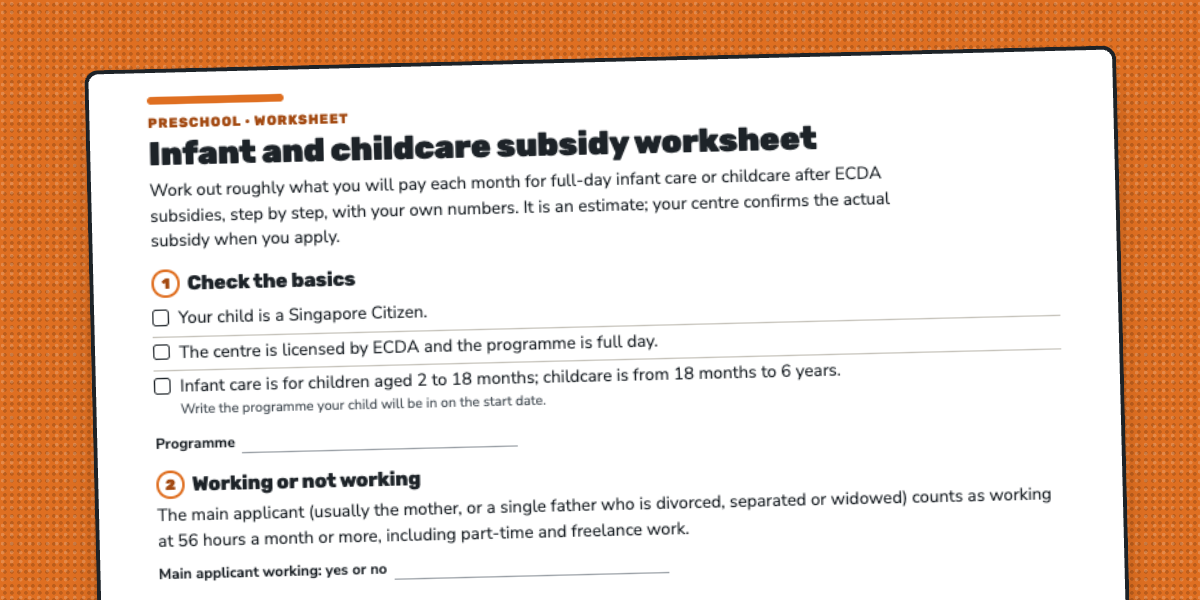
Infant and childcare subsidy worksheet
Work out your monthly full-day infant care or childcare fee after ECDA's basic and additional subsidies. The 2026 and 2027 bands are on one page.
Check the numbers for your family
See your preschool subsidy, then student care after SCFA and the credits your children get.
Work out your childcare subsidy → Student care after SCFA → Your children’s credits →Frequently asked questions
Can I get ComCare if we earn more than S$800 a person?
You can still ask. SupportGoWhere says that even if your income is above the guideline, you can approach a Social Service Office for assessment.
Does Grandparent Caregiver Relief pay my mother?
No. It is a S$3,000 income tax relief claimed by a working mother in her own tax return. Nothing is paid to the grandparent.
I am a single mother. Can I claim Grandparent Caregiver Relief?
Not if you have never married. IRAS says single or male taxpayers are not eligible. A divorced or widowed working mother can claim it.
Do I need to be working to get childcare subsidies?
Every Singapore Citizen child gets the Basic Subsidy. For childcare, a household earning S$6,000 a month or less gets full subsidies, working or not. Others can ask ECDA for Special Approval.
When should I apply for student care help?
At least 6 months before your child starts, on SupportGoWhere. For a January 2027 start, MSF says you may apply from July 2026.
Keep this guide for the next big decision.
Build your own reading list and pick up where you left off with a free RaisingAngels account.
Free account · Tools stay free without an account.
Sources & assumptions
- SupportGoWhere — ComCare assistance (MSF) ↗
- CDAC — Family Assistance Programme ↗
- M³+ — Yayasan MENDAKI ↗
- SINDA — Enhanced PCI criteria ↗
- Eurasian Association — Family Support Services ↗
- MSF — ComCare ↗
- KidSTART — Be a KidSTART family ↗
- ECDA — Infant and childcare subsidy scheme ↗
- ECDA — Other financial assistance for preschool fees ↗
- ECDA — Childminding Pilot for Infants ↗
- MSF — Financial assistance for parents whose infants are enrolled in ECDA's Childminding Pilot ↗
- ECDA — KiFAS ↗
- MOE — Financial assistance ↗
- MSF — Student Care Fee Assistance ↗
- CDC Vouchers Scheme 2026 (June) ↗
- LifeSG — SG Child Support Package ↗
- IRAS — Grandparent Caregiver Relief ↗
Check the official page before you apply.