Quick answer
A third or later child born before 1 April 2027 gets a S$10,000 CDA First Step Grant, not S$5,000, and a higher matching cap. From 1 April 2027 every child gets the same. A new baby lowers your income per person, which may help the siblings’ preschool subsidy.
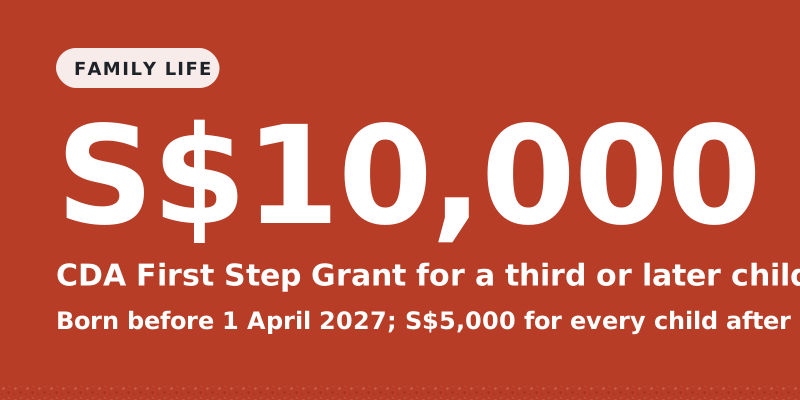
The useful number: S$10,000 CDA First Step Grant for a third or later child born before 1 April 2027; S$5,000 for every child after.
Does a new baby change the Additional Subsidy?
Enter your gross household income a month and how many people live with you now. Nothing you type leaves this page.
Gross pay, including employee CPF.
Loading the official figures…
Who is this for?
Parents expecting a second, third or later child, or thinking about one. It covers what the new baby gets, what changes for the older children and what changes at work. Each agency decides; we never promise an amount.
What does the new baby get by birth order?
Under the current Baby Bonus, a later child gets a bigger CDA grant and matching cap. Twins count as two children: LifeSG counts each twin separately.
| Birth order | Cash, with the top-up | CDA First Step Grant | CDA matching, up to |
|---|---|---|---|
| First child | S$10,000 | S$5,000 | S$5,000 (S$4,000 until 30 September 2027) |
| Second child | S$10,000 | S$5,000 | S$7,000 if saved by 30 September 2027 |
| Third or fourth child | S$10,000 | S$10,000 | S$9,000 if saved by 30 September 2027 |
| Fifth child or later | S$10,000 | S$10,000 | S$15,000 if saved by 30 September 2027 |
Born before 1 Apr 2027: LifeSG pays Cash Gift instalments until 31 Mar 2027, then the Baby Gift replaces them. A top-up by 30 Apr 2027 brings the total cash to S$10,000. So the cash is S$10,000 whatever the birth order; the First Step Grant and the matching cap still rise for later children.
Every Singapore Citizen baby also gets a S$5,000 MediSave Grant for Newborns, whatever the birth order.
A third or later child born from 18 February 2025 also brings a S$5,000 Large Family MediSave Grant into the mother’s MediSave. It is not cash. For births from 1 April 2027, LifeSG says: “More details on additional support for large families will be provided at a later date.”
Babies born from 1 April 2027 come under the SG Child Support Package. Every Singapore Citizen child gets the same: a S$10,000 Baby Gift and a S$5,000 CDA First Step Grant. All CDA matching caps become S$5,000 from 1 October 2027.
Child Credits of S$2,000 a year go to each child turning 1 to 16, from 2026. Large Family LifeSG Credits for third and later children stop after 2026.
Due near 1 April 2027? The actual birth date decides which scheme applies. Check both with the Baby Bonus + CDA maximiser.
Can the older children use the new baby’s CDA?
Yes, for approved costs. CDA savings can pay approved expenses for the child or their siblings at Baby Bonus Approved Institutions, such as childcare, kindergarten and medical bills. So the new baby’s CDA can help with an older child’s preschool fees.
Does a new baby change the siblings’ preschool subsidy?
It can. Every Singapore Citizen child at an ECDA-licensed centre gets the Basic Subsidy. The Additional Subsidy is for households earning S$12,000 a month or less, or S$3,000 a person in a household of 5 or more. From 1 January 2027, these rise to S$15,000 and S$3,400.
So a fourth person can open the per-person route. A household of 4 earning S$14,000 is above S$12,000. With a new baby it is 5 people at S$2,800 a person, within S$3,000.
- Fewer than 5 people: ECDA counts both parents’ income, even at different addresses.
- 5 people or more: ECDA counts everyone at the main applicant’s registered address, grandparents included.
- ECDA goes by the address on each person’s NRIC, FIN card or Singapore birth certificate.
- You can ask for a subsidy reassessment when your family’s circumstances change.
School help works the same way. MOE FAS is for households earning S$4,000 a month or less, or S$1,000 a person. SCFA is for households of 4 or fewer earning S$4,500 or less, or S$1,125 a person in larger households.
What changes for leave?
- Maternity leave
- 16 weeks for every birth order. For a first or second child, the employer pays the first 8 weeks at your gross rate of pay. The Government reimburses the last 8 weeks. For a third or later child, the Government reimburses all 16 weeks. Government reimbursement is capped at S$10,000 per 4 weeks.
- Paternity leave
- 4 weeks, whatever the birth order.
- Shared parental leave
- 10 weeks for babies born from 1 April 2026, shared between the parents.
- Childcare leave
- Each parent gets 6 days of childcare leave a year until the year a Singapore Citizen child turns 7, regardless of the number of children. It does not grow with a new baby.
- Unpaid infant care leave
- 12 days a year for each parent while a Singapore Citizen child is below 2. 12 days a year for each parent, however many children are under 2.
See each parent’s weeks with the Parental leave planner, and the days you have this year with the Childcare leave checker.
What extra costs should we plan for?
- The first year: delivery, confinement, gear and care. Work out yours with the First-year cost estimator.
- Years when two children are in preschool, or one at university and one in school, cost the most. See the overlap years with the Family cost projector.
- A helper: MOM’s levy concession is S$60 a month, instead of S$300, with a Singapore Citizen child below 16. It is one helper per eligible person, and at most 2 helpers per household.
Hand-me-downs, a bigger car or a bigger home depend on your family. We do not estimate them.
What should we do next?
- Put every child’s date into Our family’s year. It shows each child’s schemes this year and their next deadlines.
- After the birth, register it and apply for the Baby Bonus on LifeSG.
- If an older child is in preschool, ask the centre about a subsidy reassessment once the baby is registered at your address.
- Check the new baby’s school years, from preschool to the PSLE, with School years from birth date.
What this guide does not tell you
It does not decide whether you qualify: each agency assesses your household. Figures change, and several limits rise on 1 January 2027. If money is tight after a new baby, see Help if money is tight.
Printables for this guide
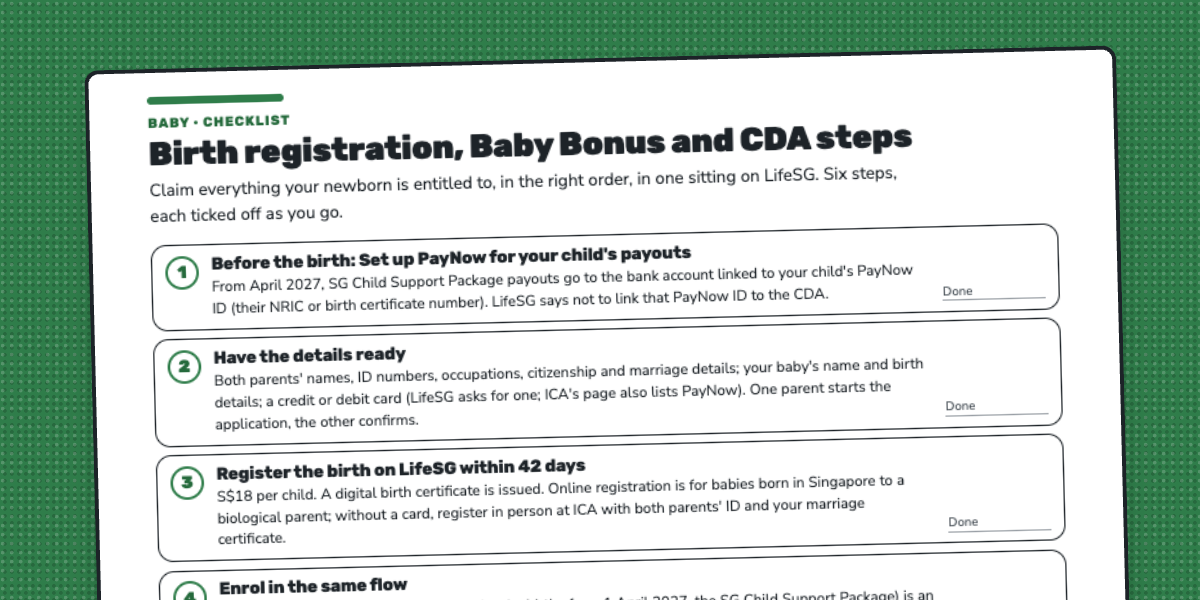
Birth registration, Baby Bonus and CDA steps
The steps in order: register the birth on LifeSG within 42 days and enrol in the same flow. Then open the CDA for the First Step Grant and co-matching.
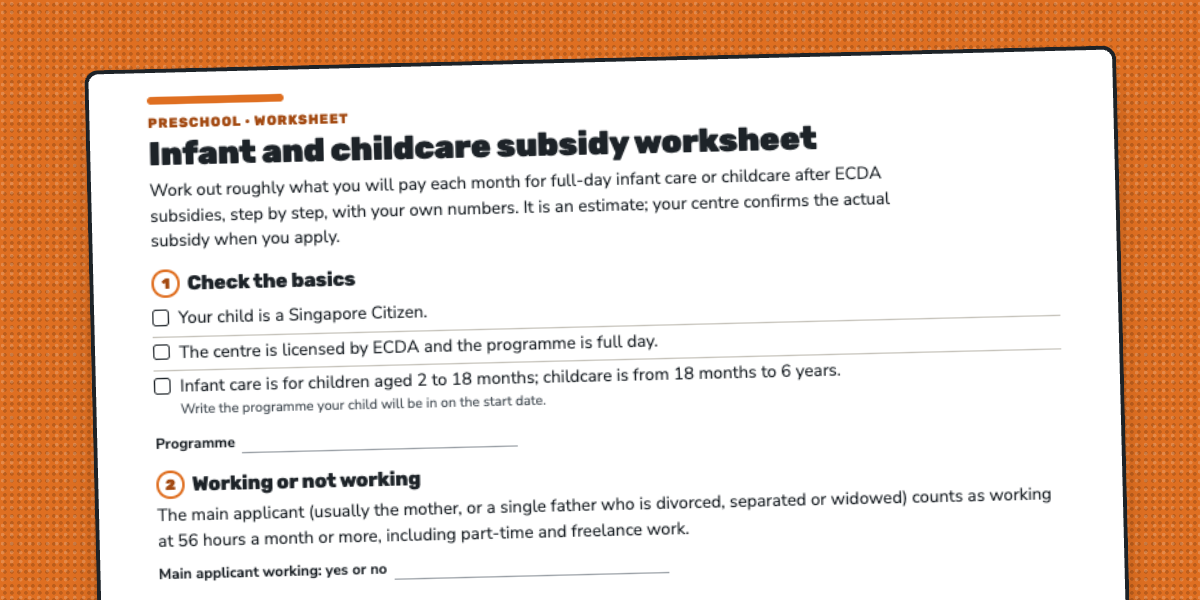
Infant and childcare subsidy worksheet
Work out your monthly full-day infant care or childcare fee after ECDA's basic and additional subsidies. The 2026 and 2027 bands are on one page.
Put in each child’s date
See what each child gets this year, each child’s next deadlines and one calendar for the family.
See every child’s schemes and dates → Family cost projector → School years from birth date →Frequently asked questions
Do twins count as two children for birth order?
Yes. LifeSG counts each twin separately, so twins born as your first children get the first- and second-child amounts.
Does a third child born after 1 April 2027 still get more?
No. Under the SG Child Support Package every Singapore Citizen child gets a S$10,000 Baby Gift and a S$5,000 First Step Grant.
Do we get more childcare leave with more children?
No. MOM gives each parent 6 days a year until the year the child turns 7, regardless of the number of children.
Does a baby on the way count in our household size?
ECDA counts family members by the registered address on their NRIC, FIN or Singapore birth certificate. Ask ECDA or your centre about a baby not yet born.
Keep this guide for the next big decision.
Build your own reading list and pick up where you left off with a free RaisingAngels account.
Free account · Tools stay free without an account.
Sources & assumptions
- LifeSG Baby Bonus Scheme ↗
- LifeSG SG Child Support Package ↗
- LifeSG Large Families Scheme ↗
- Made For Families: Baby Bonus Scheme ↗
- ECDA — Infant and childcare subsidy scheme ↗
- ECDA: Assessment of household income ↗
- MOE — Financial assistance ↗
- MSF — Student Care Fee Assistance ↗
- MOM: maternity leave eligibility and entitlement ↗
- MOM: paternity leave ↗
- MOM: shared parental leave ↗
- MOM: childcare leave eligibility and entitlement ↗
- MOM — Unpaid infant care leave ↗
- MOM levy concession ↗